Open Doors
Digital support for practitioners & multi touchpoint onboarding for users can improve mandated financial services for prison leavers
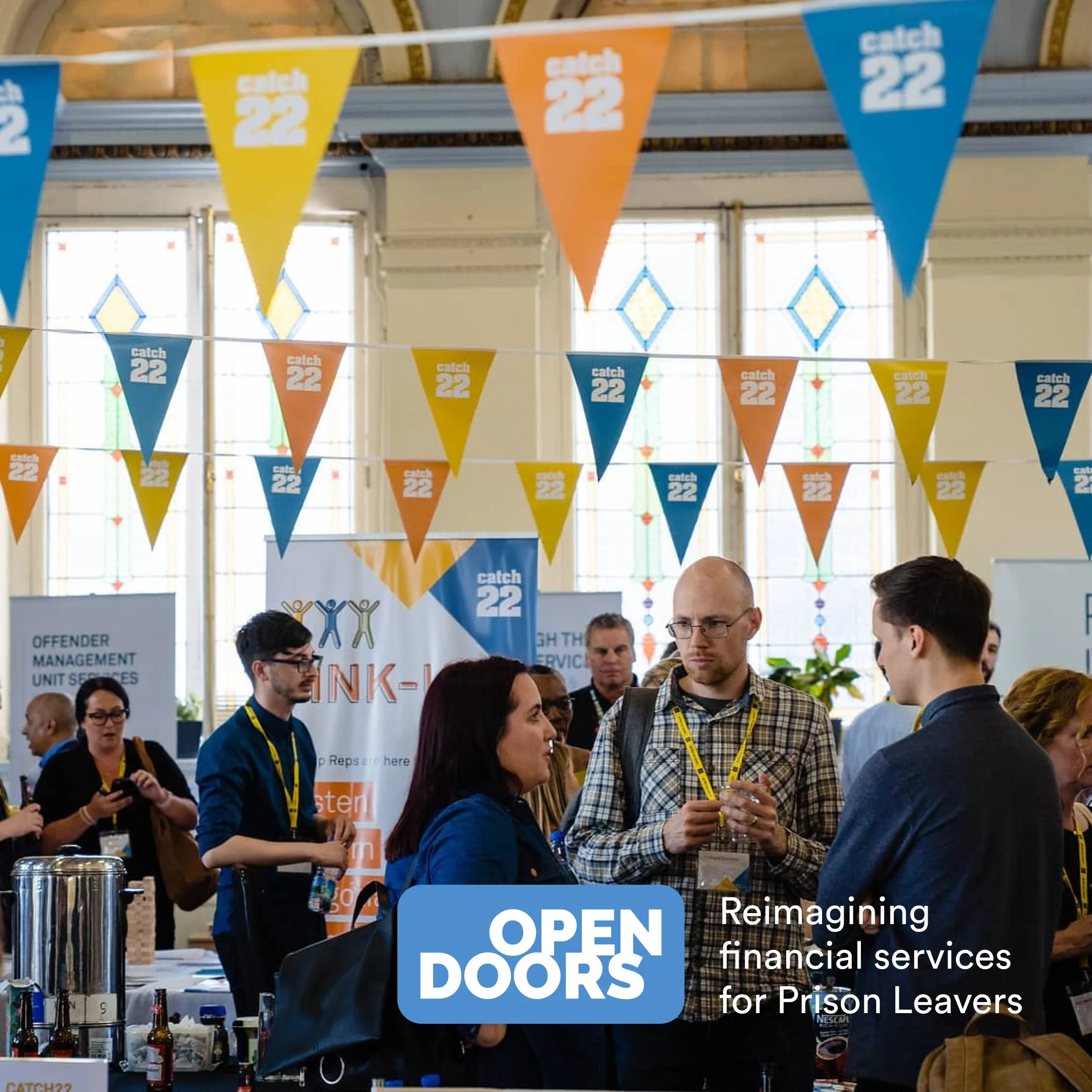
Image credit: Catch 22-
Catch 22’s Finance Benefit and Debt Team (FBD) delivers group interventions for prison leavers commissioned under a Ministry of Justice contract. They teach essential skills for managing bank accounts, navigating benefits systems, and handling debt.
However both practitioners and service users both defer to 1:1 sessions, for which there is limited capacity.Our team was asked to reimagine these group sessions to work better and interventions that existing staff could deliver immediately.
-
In academic partnership with Royal College of Art, Catch 22 & Ministry of Justice.
This project was delivered by a collaborative five-person team (Richa Kejriwal, Neha Parekh, Samanvitha AN, Joanne Yang, Xinyi Fang).
I led research and service design strategy, which included designing and facilitating workshops with designers and practitioners. Additionally, I managed project communications and served as the primary liaison between our design team and Catch 22 stakeholders. -
Open Doors is a multiple touchpoint service intervention for Catch 22's live rehabilitation program.
Ranging from events connecting users with financial experts, AI integration roadmap for practitioners to site-specific experiences in waiting spaces, Open Doors improves efficacy of existing group interventions delivered by the Finance Benefit and Debt Team.
The Challenge
For people leaving prison, accessing basic financial services isn't just bureaucratic mandate but can transform tehir lives after probation. Without bank accounts, credit histories, or financial literacy, successful reintegration becomes nearly impossible. Catch 22, one of the UK's leading criminal justice charities, supports 238,646 people on probation through just 14,400 probation officers—a ratio of 1:17. With practitioners overwhelmed and service users facing compounding barriers, the organisation needed to transform how they delivered their Finance Benefit and Debt (FBD) programme. But traditional user research methods weren't possible. Ethics and boundaries made direct access to people on probation impossible, forcing us to rethink how we could design for users we couldn't reach.
We partnered with Catch 22 to develop AI enabled journey that would enhance practitioner capacity, build user trust incrementally, and create a scalable framework for digital transformation in regulated social services.