
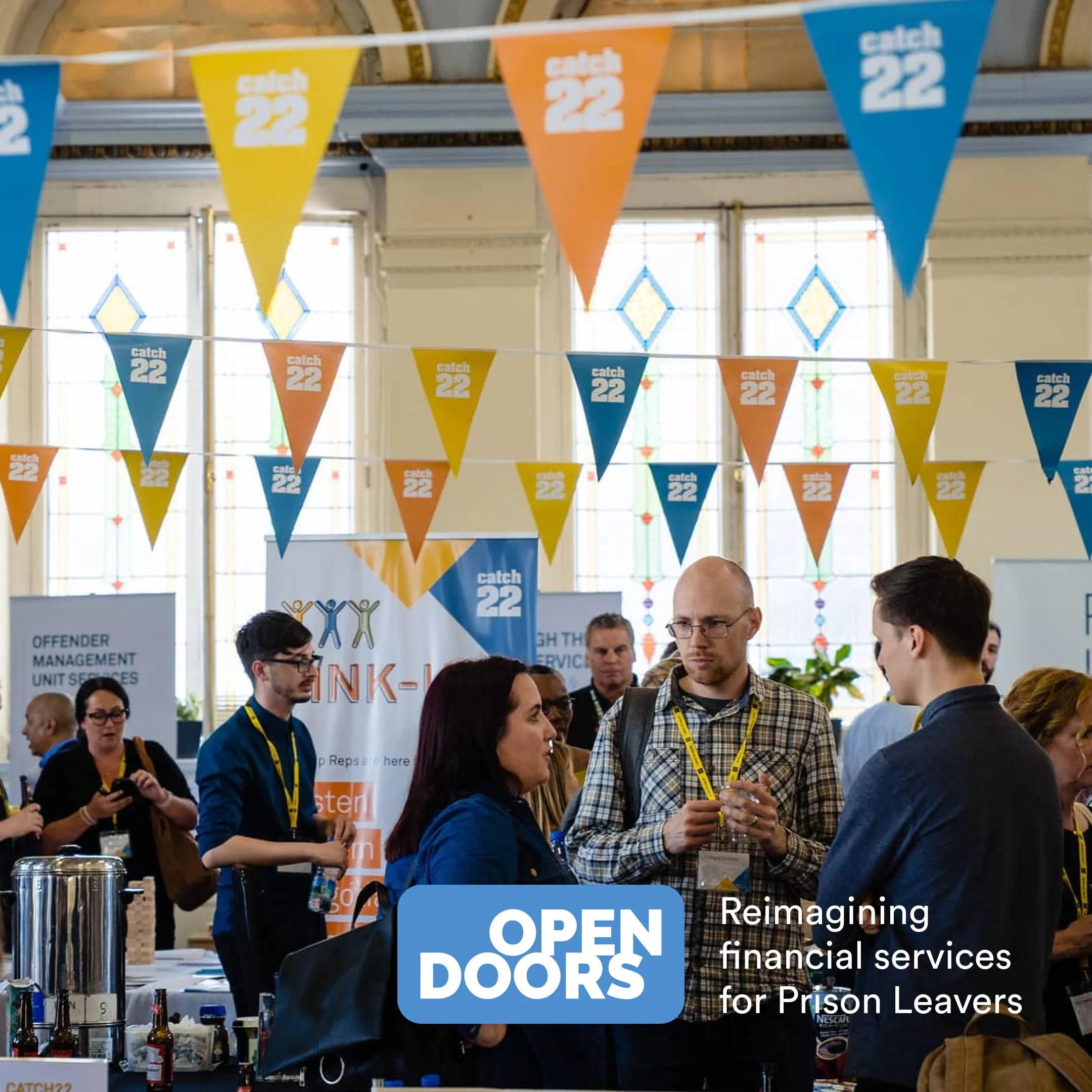
Open Doors
A multi touchpoint services to improve mandatory group intervention programme for people on probation and teams who deliver them

BRIEF: In academic partnership with Catch22 via Royal College of Art. Catch 22, is a storied third sector partner delivering probation support services under MoJ contract. This project examines group interventions by Finance, Benefit and Debt (FBD). How to increase service user engagement and practitioner support.
MY ROLE: Research lead for proxy user workshops, facilitation for practitioner simulation session, AI integration roadmapping, narrative and strategic framing and sense making.
TEAM: Richa Kejriwal, Neha Parekh, Samanvitha AN, Joanne Yang, Xinyi Fang.
CONTEXT
In England and Wales, 238,000 people are on probation at any given time. They are legally required to attend support programmes, including financial literacy interventions, but the conditions that would make those programmes effective are rarely in place.
238k
People on probation in England and Wales
1:17
Ratio of probation officers to service users
£18b
Annual cost of the criminal justice system
The structural challenges go beyond numbers. Service users enter the programme facing:
Mandatory attendance that removes intrinsic motivation from the outset
Lack of agency to continue with practitioner from 1:1 sessions and location and timing of group interventions
Practitioners stretched across documentation, facilitation, and 1:1 case management simultaneously
Image: Current journeys for service user and practitioner that lead them to Group Interventions
“I don’t understand how this will really help me”
- Service Users (People on probation)
“We have a hard time getting them to come in the first place”
- Service Provider (Practitioners)
RESEARCH METHOD
Our 3 main assumptions about the problem were that
Content could have been unvaried and difficult to understand
Method of delivery it may not be adapted to different learning styles
Timing of sessions could make information retention and relevance were low.
Research dismantled all three. The content was thoughtfully designed. The failures were entirely upstream and around it.
CONSTRAINTS
Ethical constraints, safeguarding requirements, and the nature of probation as a legal condition meant we couldn't speak to current service users (people on probation currently). Rather than treating this as a limitation to work around, we treated it as a design condition to work with and shape our research methods around this.
Image: Research Workshop with In house Record members
Image: Research Workshop with In house Record members
PROXY USER WORKSHOP
WHAT
A role play based scenario, walk through journeys to develop personas that reflect behaviours for specific age personas to help define dispositions, motivations and needs.
WHO
3 Prison leavers, members of In-house records. In house Records is record label to help reduce reoffending through music education, production, and rehabilitation.
DISCOVERY
Through developing personas we mapped motivations, capabilities and opportunities that drive behaviour change.
Want to complete probation without violations
Want to build stable relationships with family.
Frustrations by criminal record blocking employment options
Lack of in demand skills and digital education/ lack of access to resources.
Need mental health resources to support all other changes
Ways to develop sense of community, access to services and skills
TAKE AWAYS
Prison leavers most want to build social connections
Most incarceration have difficulty building trust
Need support need help navigating bureaucratic systems
PRACTITIONER SIMULATION WITH LALITHA
WHAT
The team of designers and researchers played service users as Lalitha conducts a FBD session. She assigned four archetypes surfaced in real time like Not Open to Sharing, Distracted, Trouble Reading, and Talkative.
WHO
Co-designed a live simulation of a group session Lalitha, Catch22 FBD practitioner.
DISCOVERY
The session broke was pivotal in reshaping our assumptions about content design, delivery style and the challenges around it.
TAKE AWAYS
The current sessions are Interactive and inclusive
A high degree of discretion based on practitioner
Delivery with empathy matters more than format itself
DESIGN OPPORTUNITY
How might we support women during phases of diagnostic limbo to receive support across their journey as they navigate complex medical systems?
REFRAME & REDEFINE
Image: Co-design workshop, engaging both patients, medical practitioners.
PRACTITIONER SIMULATION WITH LALITHA
WHAT
The team of designers and researchers played service users as Lalitha conducts a FBD session. She assigned four archetypes surfaced in real time like Not Open to Sharing, Distracted, Trouble Reading, and Talkative.
WHO
Co-designed a live simulation of a group session Lalitha, Catch22 FBD practitioner.
DISCOVERY
The session broke was pivotal in reshaping our assumptions about content design, delivery style and the challenges around it.
TAKE AWAYS
The current sessions are Interactive and inclusive
A high degree of discretion based on practitioner
Delivery with empathy matters more than format itself
Interviews and co-design workshops deepened our understanding of both patient and healthcare provider behaviours. Initial ideation spanned experiential, technological, financial, and social models.
Self-initiated suggestions
Tools to develop self-advocacy skills and confidence
Support for emotional and mental wellbeing
Behavioural change resources for patients navigating uncertainty
Systems-led ideas
Mapping touchpoints across public and private sectors
Identifying leverage points to improve patient experiences
Enhancing interactions between patients and providers
Image: Mapping patient behavioural traits
KEY TAKEAWAY
A patient's mindset is a key factor in navigating diagnosis limbo, especially when external systems fall short.
Developing the right mindset empowers patients to take an active role in their health, even in ambiguity. Key influencing factors include:
Outlook and disposition
Emotional regulation and cognitive state
Health literacy and sense of agency
System dependence and social context
BREAKTHROUGH
Diagnosis limbo should not be treated merely as the absence of a diagnosis rather a diagnosis in itself.
STRATEGY & SOLUTION
Introducing DiaLog, a platform-as-a-service, empowers patients to track symptoms, store records, and access trusted medical insights. It offers personalized guidance for medical conversations, connects users with global doctors, and visualizes key health patterns. Patients can find and connect with others on similar journeys and contribute to research that advances gender inclusive care.
Image: Patient facing App - DiaLog
DIALOG: SERVICE BLUEPRINT
DIALOG: SUSTAINABLE BUSINESS MODEL CANVAS
IMPACT
*Projected based on feedback from HCPs and research participants.
↓ 5-10%
Reduced repeat GP visits. By improving narrative continuity and consultation readiness, fewer appointments are used to re-explain symptoms or restart diagnostic conversations.
↑ 2-3min
More efficient consultations. Structured histories and clearer priorities support faster context-building. More focused clinical conversations within time-limited.
↑ 15-18%
Improved patient confidence Validation, continuity, and guided sense-making reduce anxiety and increase perceived agency during prolonged uncertainty.
FEEDBACK
“This project took our breath away. DiaLog looks at the problem of diagnosis limbo from multiple angles and provides a number of ways to track, understand, and connect around symptoms. The service is robust and offers a unique and fitting experience for every individual. We commend the team for using both qualitative and quantitative research to design a service with empathy at its core”
— Philips' Team
“DiaLog is a standout project in both societal relevance and design excellence. It successfully reframes diagnosis limbo as a condition worthy of recognition. DiaLog stands out as a model for responsible, inclusive service design in healthcare. It refines an eclectic experience. Delivers a credible and compassionate solution and demonstrates the systemic potential of design. When it centers human dignity. It bridges the gender health gap. Of women with measurable psychological and systemic benefits.”
— Eliisa Sarkkinen (Chapter Lead of the Service Design Network Finland)
“I would put all my notes and medical references into DiaLog if it existed. It simplifies things a lot.”
— Patient in 4-Year Diagnosis Limbo
“DiaLog will allow patients to feel satisfied in their approach to their illness and help build better interpersonal relationships, which invariably leads to better healthcare.”
— NHS Medical Doctor (MD)