

Open Doors
A multi touchpoint service to improve a live programme for people on probation, via group interventions and the teams who deliver them.
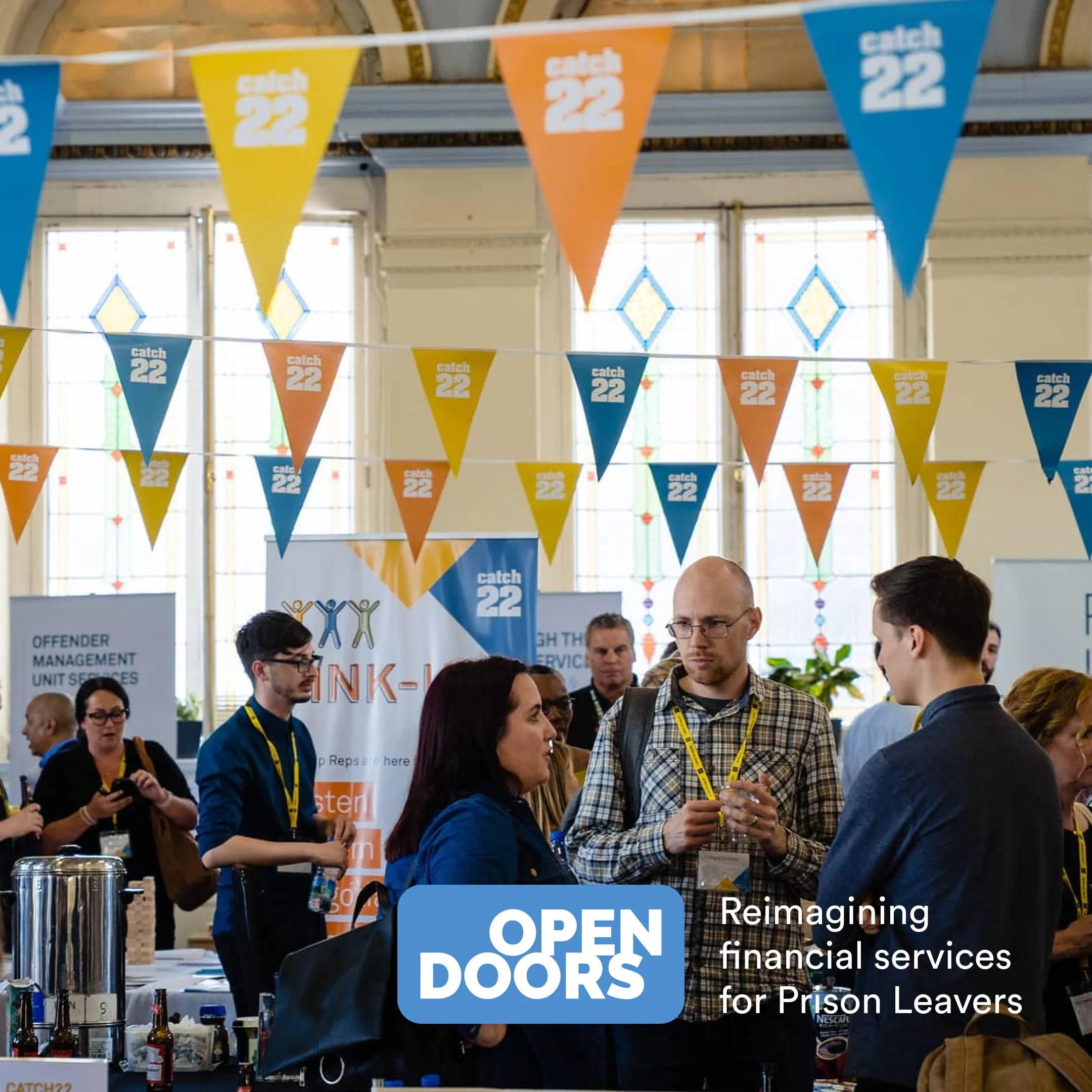
PROJECT OVERVIEW
Client & Context
Academic partnership with Catch22 via the Royal College of Art, focused on improving mandatory Finance, Benefit and Debt group interventions delivered under a Ministry of Justice commissioned contract.
My Role
I was the research lead, architect of proxy user workshops, practitioner simulation facilitation, stakeholder interviews, AI integration roadmapping, narrative framing, strategic synthesis, and sense-making
Team
5 person RCA service design team working with Catch22 FBD practitioners and external research participants.
Duration
October 2024 – February 2025.
Core Challenge
How might we increase the perceived value of mandatory group interventions for people on probation, while also improving delivery operations for practitioners?
Outcome & Impact
Recommended a 3 touchpoint service strategy anchored around trust, clarity, and practical value. Proposed interventions that would increase community engagement, with projected reductions 60%+ practitioner admin load and improved programme completion rates by 15%.
CONTEXT
In England and Wales, 238,000 people are on probation at any given time. They are legally required to attend support programmes, including financial literacy interventions, but the conditions that would make those programmes effective are rarely in place.
238k
People on probation in England and Wales
1:17
Ratio of probation officers to service users
£18b
Annual cost of the criminal justice system
The structural challenges go beyond numbers. Service users enter the programme facing:
Mandatory attendance that removes intrinsic motivation from the outset
Lack of agency to continue with practitioner from 1:1 sessions and location and timing of group interventions
Practitioners stretched across documentation, facilitation, and 1:1 case management simultaneously
Financial Literacy is a mandated programme for people on probation delivered by Catch 22’s Finance Benefit and Debt team (FBD), commissioned by the Ministry of Justice. It is delivered via both 1:1 and group interventions.
Image: Service Mapping for current financial literacy programme delivered by Finance Benefit and Debt team at Catch22.
“I don’t understand how this will really help me”
- Service Users (People on probation)
“We have a hard time getting them to come in the first place”
- Service Provider (Practitioners)
RESEARCH METHOD
Our 3 main assumptions about the problem were that
Content could have been unvaried and difficult to understand
Method of delivery it may not be adapted to different learning styles
Timing of sessions could make information retention and relevance were low.
Research dismantled all three. The content was thoughtfully designed. The failures were entirely upstream and around it.
CONSTRAINTS
Ethical constraints, safeguarding requirements, and the nature of probation as a legal condition meant we couldn't speak to current service users (people on probation currently). Rather than treating this as a limitation to work around, we treated it as a design condition to work with and shape our research methods around this.
Image: Research Workshop with In house Record members
01 PROXY USER WORKSHOP
WHAT
A role play based scenario, walk through journeys to develop personas that reflect behaviours for specific age personas to help define dispositions, motivations and needs.
WHO
3 Prison leavers, members of In-house records. In house Records is record label to help reduce reoffending through music education, production, and rehabilitation.
DISCOVERY
Through developing personas we mapped motivations, capabilities and opportunities that drive behaviour change.
Want to complete probation without violations
Want to build stable relationships with family.
Frustrations by criminal record blocking employment options
Lack of in demand skills and digital education/ lack of access to resources.
Need mental health resources to support all other changes
Ways to develop sense of community, access to services and skills
TAKE AWAYS
Prison leavers most want to build social connections
Most incarceration have difficulty building trust
Need support need help navigating bureaucratic systems
Image: Practitioner Simulation with Lalitha
02 PRACTITIONER SIMULATION WITH LALITHA
WHAT
The team of designers and researchers played service users as Lalitha conducts a FBD session. She assigned four archetypes surfaced in real time like Not Open to Sharing, Distracted, Trouble Reading, and Talkative.
WHO
Co-designed a live simulation of a group session Lalitha, Catch22 FBD practitioner.
DISCOVERY
The session broke was pivotal in reshaping our assumptions about content design, delivery style and the challenges around it.
TAKE AWAYS
The current sessions are Interactive and inclusive
A high degree of discretion based on practitioner
Delivery with empathy matters more than format itself
03 STAKEHOLDER INTERVIEWS
WHAT
Interviews with Catch22 FBD staff across six roles: Lalitha, Harry, Maria, Carl, Toni, Elliott. Academic supervision: Judah. Mapped the provider-side experience from referral through to MoJ reporting.
"I personally feel staff confidence is a challenge when selling and engaging service users to attend group. Lack of information from the initial point of conversation at the assessment stage is also a factor which I don't feel confident that it is being covered." — Catch22 FBD practitioner
UNDERLYING FACTORS AFFECTING SERVICE USERS
Research surfaced three structural conditions shaping every interaction not design problems, but system conditions that any design response has to work within:
No / Low Agency: attendance is compelled by licence conditions, removing intrinsic motivation before the first session begins.
High Stakes + Consequences: non-attendance has legal implications; the emotional weight of this is present in every interaction.
Emotionally charged: service users arrive carrying anxiety, stigma, and prior negative system experiences. Trust is hard-won and easily lost.
KEY FINDING
Incentive structures shape everything and nobody talks about them. Mandatory attendance removes intrinsic motivation.
Tangible, immediate outcomes like a bank account opened, a debt letter explained resonate far more than abstract financial confidence. Age and life stage significantly shape receptivity; older participants are more likely to see financial literacy as personally urgent.
Image: Stakeholder mapping for the FBD programme
DESIGN OPPORTUNITY
How might we increase the perceived value of FBD’s group interventions for service users.
STRATEGY & SOLUTION
STRATEGIC ANCHOR: SHOW VALUE + BUILD TRUST
Research pointed to a the strategic conclusion that for any a single intervention was reimagined or for this programme to work, it needed to demonstrate value and earn trust at every stage, for both service users and practitioners.
Three pillars followed:
Accessible and Consolidated Service
Clear Communication
Practical and Credible Resources
Organisational challenges shaped every design decision. Data privacy and sensitive information handling. Regulated HR practices limiting the use of lived experience experts. MoJ contract requirements. Limited digital access and literacy among service users. Scheduling and logistics. These weren't barriers to acknowledge and move past but were constraints to design within.
3 INTERVENTIONS, 1 JOURNEY
Image: Multi touchpoint Interventions across FBD journey.
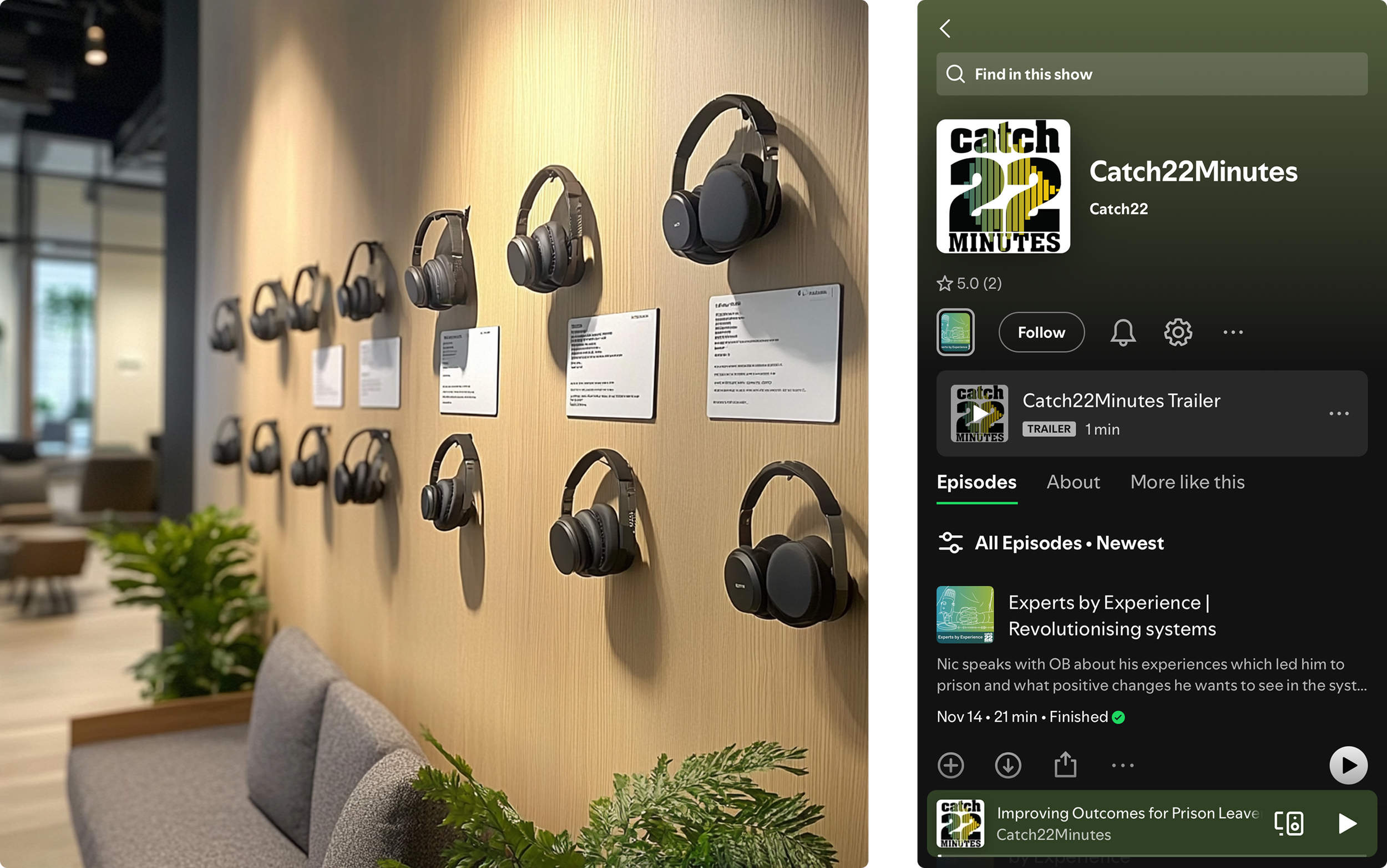
Image: Audio Wall in wait hubs (AI generated); Right: Catch22 Podcast
01 Audio wall
WHEN: Before session · Waiting area at hubs
WHO: Service User Touchpoint
The waiting area at Catch22 hubs is currently undesigned, anxiety-amplifying time. The Audio Wall leverages a resource Catch22 already has: the Experts by Experience podcast series. Headphones mounted on a wall let service users hear stories from people who've navigated the system, not as a formal orientation, but as ambient peer presence. This not a service in itself but rather an introduction.
Benefits:Trust building onboarding touchpoint and allows service users to contribute their own stories, building a proprietary Voice of User repository for Catch22's programme improvement and MoJ reporting.
Considerations: Requires addition budget and active maintenance for equipment and technical support.
KEY TAKEAWAY
Build trust and transparency before a potentially high-anxiety sessions can help with reception of programme.
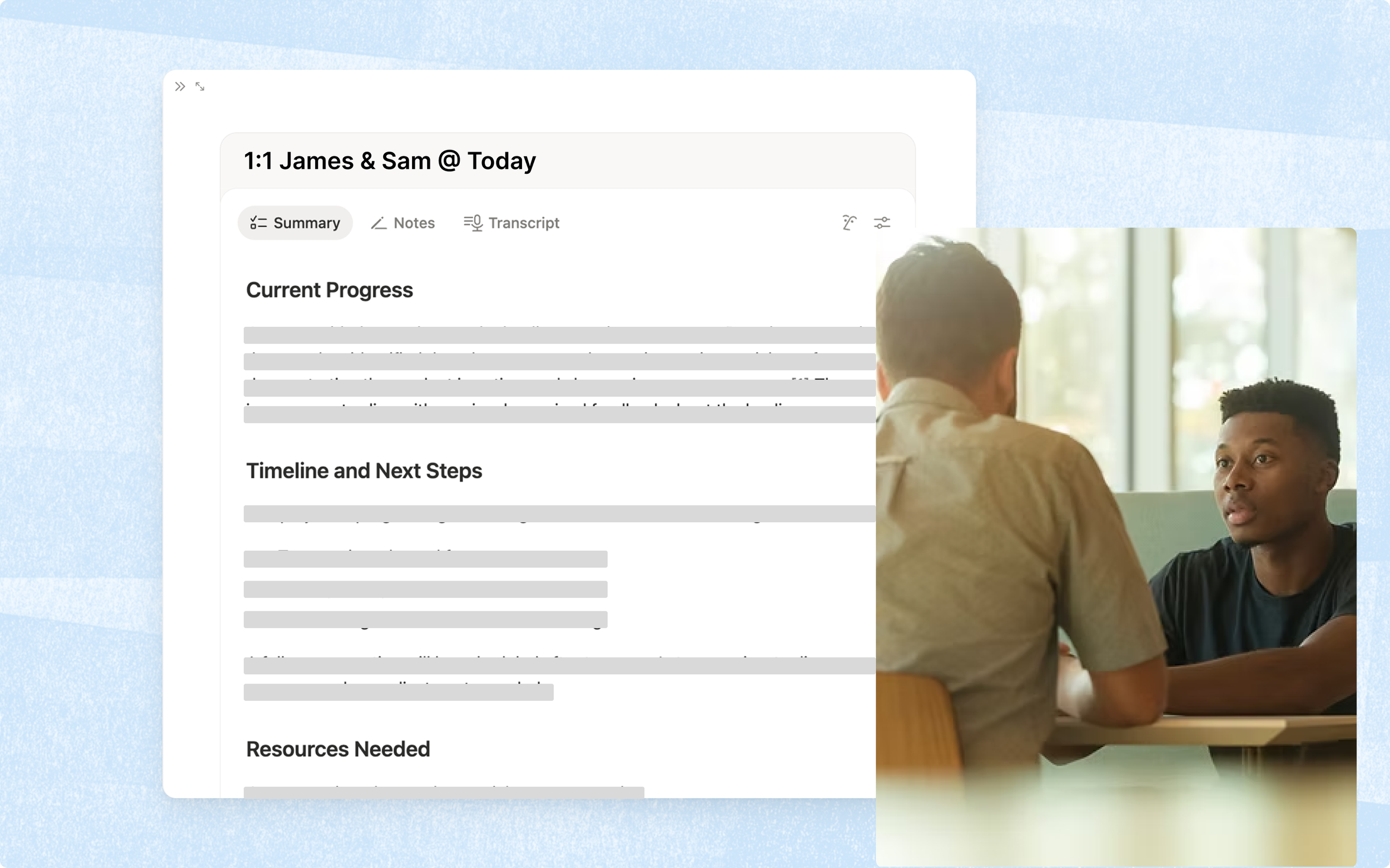
Image: AI Integration for in-person sessions (AI generated)
02 AI Integration and pattern analysis
WHEN: During 1:1 sessions before group interventions
WHO: Practitioner-facing touchpoint
Practitioners are split-brain during these onboarding sessions. One part is present with the service user; another is writing notes that will need to be cleaned up later for MoJ reporting. The AI note-taking tool removes the documentation burden so practitioners can be fully present not replacing practitioner judgement, but freeing their attention for what no AI can replicate: human connection in a high-stakes moment.
Benefits: Automated transcription and post-session summarisation; progress and pattern tracking across cohorts; standardisation of documentation quality; reduction of MoJ reporting overhead.
Considerations: Leverage existing AI transcription services for cost efficiency; privacy-first, GDPR-compliant by design; explicit consent workflow for all recordings; scalable across Catch22's full service portfolio.
KEY TAKEAWAY
Having data to better group service users, feedback channels and training guides for new practitioners.
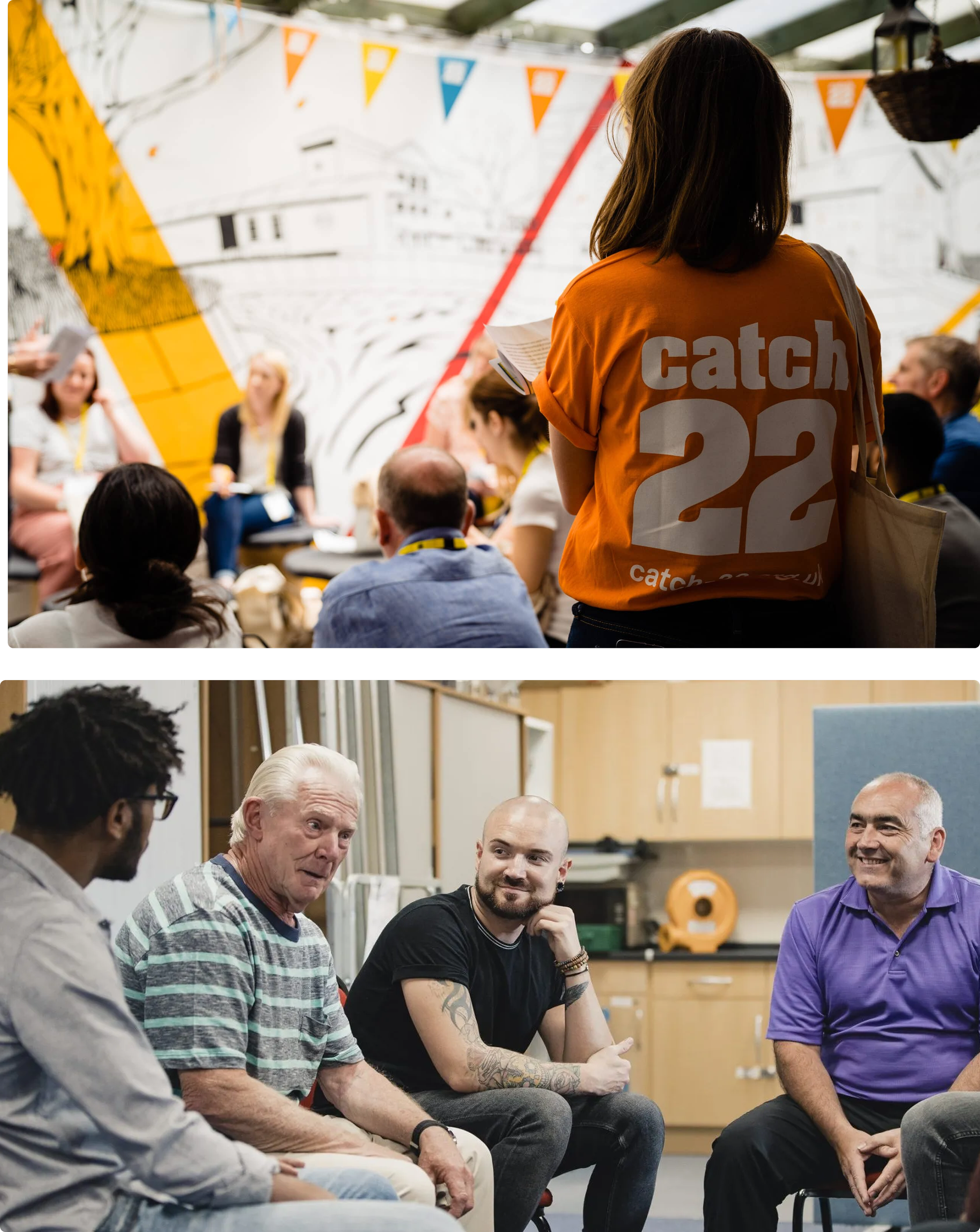
Image: Community event Open doors (AI generated)
03 Open doors
WHEN: During probation Quarterly community setting
WHO: Service and Practitioner Touch points
A quarterly pilot event held at a local community hall and not a probation office. A neutral communal space removing institutional weight and building a community resource fair. Service users can connect with debt and benefits advisors, financial specialists, and lived-experience volunteers. 1:1 drop in tables sit alongside group sessions and volunteer-led talks. Essential resources like banking forms, birth certificates applications, local community links are available in one place. Service users can return to future Open Doors events even after probation ends, creating a voluntary relationship with Catch22 that outlasts the legal mandate.
Benefits:Trust building onboarding touchpoint and allows service users to contribute their own stories, building a proprietary Voice of User repository for Catch22's programme improvement and MoJ reporting.
Considerations: Requires addition budget and planning for space, equipment and support from volunteers.
KEY TAKEAWAY
Resources centres and activities build long term and ongoing relationships and help program completion and also optimise resources.
IMPACT
*Projected based on feedback from FBD practitioners and research participants.
↓ 60%
Reduced practitioner admin load. The AI note-taking tool returns an average of 40 minutes per day to direct service user engagement and time previously spent on manual post-session write-ups and MoJ documentation.
↑ 10-15%
Improved programme completion rates. Cohorts supported end to end by practitioners with consistent session preparation show higher rates of completing mandatory FBD interventions.
FEEDBACK
"What this team proposed is exactly the kind of multi-pronged approach we need. Too often practitioners are asked to do more with less. More service users, more paperwork, less time for the actual conversations. The AI note-taking tool and the Open Doors event work together in a way that makes it easier for us to prepare, to be present, and to give them a genuine reason to come back. "
— Lalitha, FBD Practitioner, Catch22